Fishing, farming, cattle — the three legs our life stood on. And beneath them all, the deepest tradition of the Luo: nobody works alone. This is the page of the hands.
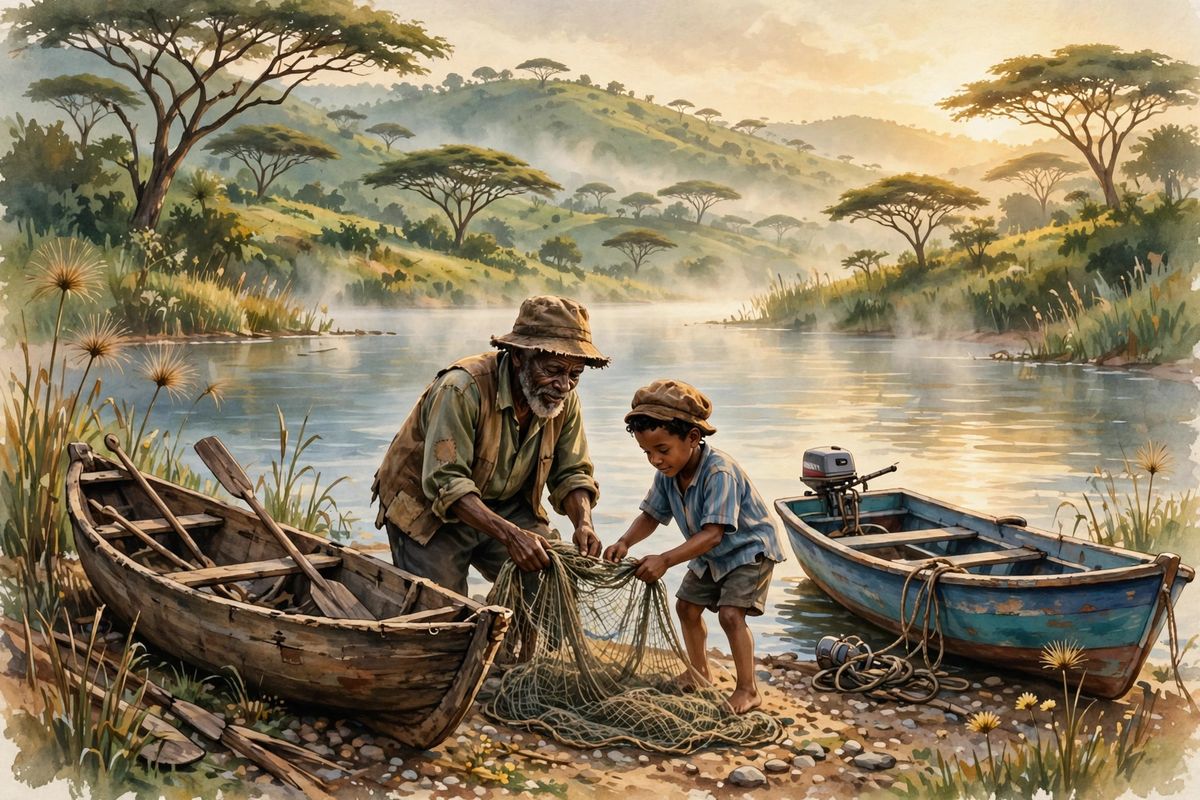
Life around the lake rested on three legs — fishing, farming and livestock — with the fields first and the lake filling the seasons between planting, weeding and harvest. The old fishing gears were ingenious and gentle on the water: basket traps and baited traps, hooks and spears, beach seines woven from papyrus and reed, sisal longlines, and weirs built across streams and inlets. The fishermen worked from dugout canoes, and later from sewn-plank boats.
The elders guarded the fishery with rules — closed seasons and restrictions on methods — so the lake would keep feeding everyone. And before a voyage, the crew leader, the Mwasia mar Yie, blessed the canoe, spraying lake water from his mouth and asking the lake's blessing on the crew. The prized catch was ngege — tilapia — alongside catfish and the little silver omena.
The tiny silver fish called omena sleeps deep by day and rises at night. On moonless nights, crews of up to five float lanterns on the water; the fish gather to the light and are scooped or seined in. Seen from the shore, hundreds of lamps make a glittering city on the lake — at Rusinga and Mfangano people call it the "Ghost Town" — and by morning it is gone. Kerosene pressure lamps are now giving way to solar lamps that burn all night, and at dawn the catch passes to the women, who sun-dry it on racks and rocks for markets across East Africa.
The lake today carries new pressures — introduced Nile perch and heavy fishing — and the community's modern answer is the elders' old answer in new clothes: the Beach Management Units, elected bodies of the fishing community itself that guard each landing beach. Homa Bay County's BMU Network counts 143 landing sites in one network, and the units are now forming cooperatives so fishers can pool and sell their catch as one — and win a fairer price together.
Not all our work was on the water. A small, specialised body of women potters, clustered around the clay sources, made the cooking pots, water jars and serving vessels of every homestead — a craft kept alive today by groups like the Oriang women's pottery group and Homa Bay's own Mama Nyungu ("pot lady") group. Luo artisans forged iron hoes and tools, wove baskets and reed mats, and carved wooden handles for the local markets — the homestead's whole material world, made by the people's own hands.
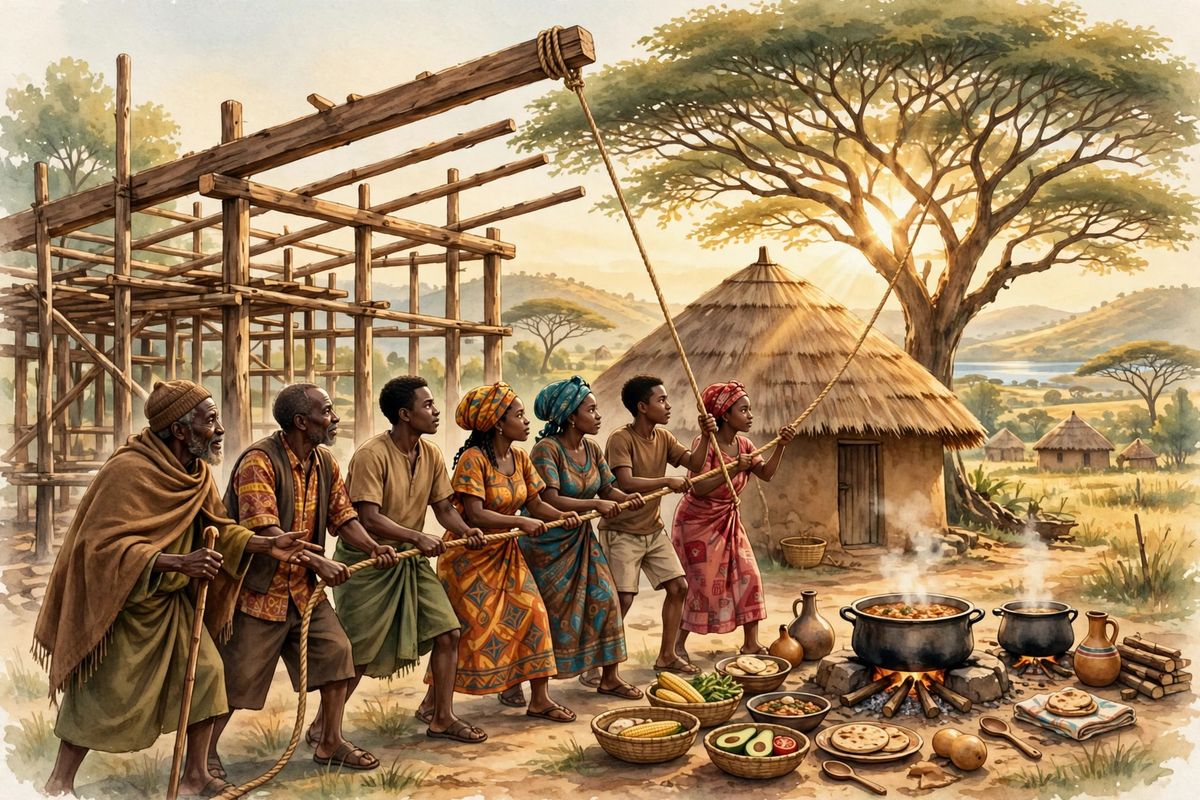
But the deepest work tradition is not a tool. It is a habit: konyir — the communal work party, the Luo form of what all Kenya calls harambee, "pull together." Neighbours organised in groups — men together, women together — and cultivated each other's fields in turn, cleared bush, harvested, and built houses for one another. It was never charity. It was reciprocal obligation, repaid in kind, and standing outside it was scarcely thinkable.
The pattern still shows its face whenever a new home is raised by goyo dala: the whole community turns out to build, and the day ends the old way — with a shared meal of kuon and stew, eaten together. Riwruok e teko — unity is strength — is not a slogan on this shore. It is how the work has always been done.